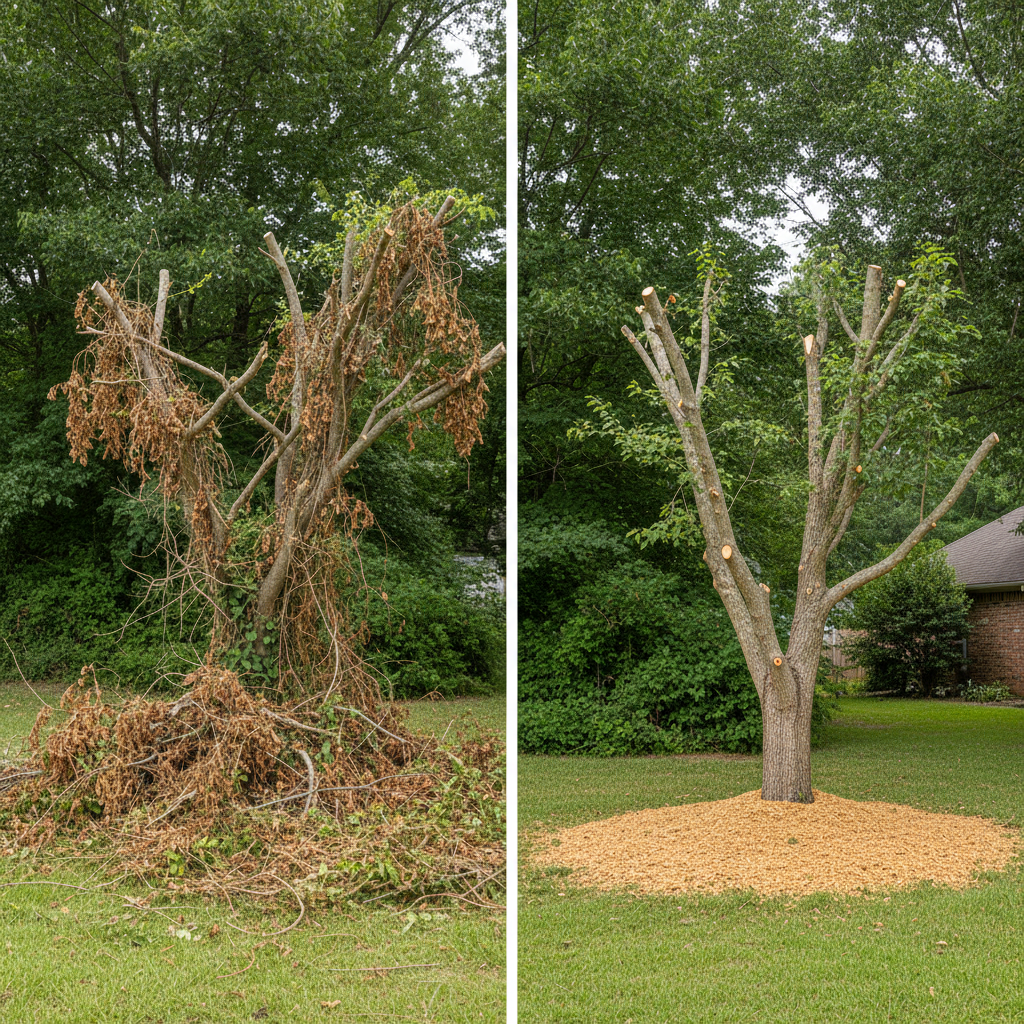
Got trees on your property? Sooner or later, they're going to need a trim. Maybe they're getting too big, blocking your view, or just looking a little wild. When it's time to call someone in, or even if you're thinking about tackling some of the work yourself, you'll hear about different ways to cut a tree. But here's the thing: not all cuts are created equal. There are two main approaches folks often consider, and one is almost always a bad idea, especially for our trees right here in Huffman.
What's the Deal with Topping?
Topping, sometimes called 'hat-racking' or 'lopping,' happens when someone chops off a big chunk of a tree's crown. They'll often cut main branches back to stubs, drastically reducing its height. People usually do it to make a tree smaller fast, or because they think it'll make the tree safer in a storm. You see it quite a bit around here, especially after a big storm when folks are worried about branches hitting their roof.
Here's the honest truth about topping:
- Cost: At first glance, it might seem cheaper. It's a quick, brute-force method, after all. Less skill involved, quicker job.
- Durability: This is where it really falls apart. Topping puts a huge amount of stress on the tree. It creates large wounds that just don't heal well, leaving the tree wide open to disease, insect infestation, and rot. The new growth that sprouts from these stubs? It's usually weak and poorly attached, making the tree *more* likely to break in future storms, not less. Think about those strong winds we get coming off Lake Houston – weak branches are a real hazard, aren't they?
- Maintenance: You'll find yourself needing to top it again, and again, and again. The tree will try its best to recover by sending out a flush of fast-growing, weak shoots. This means more frequent, more expensive, and ultimately more damaging pruning cycles.
- Appearance: Ugly. Plain and simple. It completely destroys the tree's natural shape, leaving it looking mutilated and unnatural.
Structural Pruning: The Smart Choice
Structural pruning, which you might also hear called crown thinning or corrective pruning, is a much more thoughtful, skilled approach. It focuses on taking out specific branches to make the tree healthier, stronger, and better looking overall. It's all about making the tree's natural form even better, not ruining it.
Here's what structural pruning brings to the table:
- Cost: It might cost a bit more upfront than a quick topping job. That's because it takes skilled arborists who actually understand tree biology and the right cutting techniques. But it's an investment that really pays off in the long run.
- Durability: This is the big win, folks. By removing dead, diseased, or crossing branches, and carefully thinning the crown, you're improving air circulation and letting more light get through. This encourages stronger, healthier growth. It also cuts down on the chance of branches breaking during high winds, which is super important for our mature oaks and pecans around Huffman. Proper cuts heal much quicker, keeping the risk of decay and pests way down.
- Maintenance: When done correctly, structural pruning means you won't need to prune as often. You're setting the tree up for long-term health and stability, meaning fewer interventions down the road.
- Appearance: A tree that's been well-pruned just looks beautiful. It keeps its natural grace and form, making your property look even better.
My Recommendation for Huffman Homeowners
Look, I've been doing this a long time with New Look Tree, and I've seen the aftermath of both approaches. For your trees here in Huffman, with our hot, humid summers, occasional droughts, and sometimes violent storms, structural pruning is really the only way to go. Topping is a short-sighted, damaging practice that will cost you more in the long run, both in money and in the health of your trees.
Our local soil, often a mix of sandy loam and heavier clay, combined with our weather patterns, means trees need all the help they can get to stay strong. Don't let anyone tell you topping is good for your tree. It's not. It's a quick fix that just creates long-term problems.
When you're ready to prune, find someone who truly knows what they're doing. Someone who understands tree biology and practices proper arboricultural techniques. Your trees are an investment in your property and a vital part of our local environment. Treat them right, and they'll thrive for years to come.